

Acne is one of the most common skin conditions I treat at Rangel Dermatology, but not all acne is the same. Some patients primarily struggle with blackheads and clogged pores, while others develop red, painful pimples or deep cysts that can leave permanent scars.
Understanding what causes acne and which type of acne you have is important because different types often require different treatments.
What Causes Acne?
Acne develops within the pilosebaceous unit, which is the medical term for a hair follicle and its associated oil (sebaceous) gland.
While acne may look like a simple pimple on the surface, several processes are happening underneath the skin. The four major contributors to acne are:
- Clogged pores
- Excess oil (sebum) production
- Acne-associated bacteria
- Inflammation
Hormones, genetics, skincare products, medications, and potentially diet can also influence these processes.
1. It Starts With a Clogged Pore
One of the earliest steps in acne formation happens before you can even see a pimple.
Normally, dead skin cells are shed from the lining of the hair follicle. In acne-prone skin, these cells can become sticky and accumulate inside the follicle rather than shedding normally.
When these dead skin cells combine with oil, they create a microscopic plug called a microcomedo.
This is essentially the beginning of an acne lesion.
As the plug grows, it can eventually become one of two familiar types of acne:
Whiteheads
A closed comedone, commonly called a whitehead, occurs when the clogged pore remains covered by a thin layer of skin.
Blackheads
An open comedone, or blackhead, occurs when the clogged pore opens to the surface.
Despite a common misconception, the dark color of a blackhead is not dirt. Blackheads do not mean your skin is dirty, and scrubbing your face more aggressively will not necessarily make them disappear.
2. Oil Production Plays an Important Role
Your sebaceous glands naturally produce an oily substance called sebum, which helps lubricate and protect your skin.
People who are prone to acne may produce more sebum, giving dead skin cells more material to combine with and increasing the likelihood of clogged pores.
This is one reason acne commonly develops in areas of the body with many oil glands, including the:
- Face
- Neck
- Chest
- Upper back
- Shoulders and upper arms
- Areas around and behind the ears
3. Hormones Can Drive Acne
Hormones—particularly androgens such as testosterone and dihydrotestosterone (DHT)—can stimulate the sebaceous glands to grow and produce more oil.
This helps explain why acne commonly appears or worsens during periods of hormonal change.
Hormonal influences can also contribute to acne in adulthood, which is why some patients continue to experience breakouts well beyond their teenage years.
Hormones are only one piece of the acne puzzle, however. Having acne does not necessarily mean that you have abnormal hormone levels.
4. Acne-Associated Bacteria Contribute to Inflammation
A bacterium historically known as Propionibacterium acnes lives within the hair follicles and plays an important role in acne.
These bacteria interact with the oil inside the follicle and can trigger an inflammatory response from the immune system.
This inflammation helps transform a clogged pore into the red, swollen, tender pimples that most people associate with an acne breakout.
How Does a Clogged Pore Become a Pimple?
The progression often looks something like this:
Microscopic clogged pore → whitehead or blackhead → inflammation → red pimple or pustule → deeper nodule or cyst
When the contents of a clogged follicle rupture into the surrounding skin, the immune system responds with inflammation.
The deeper and more intense that inflammation becomes, the greater the risk of developing painful nodules, cysts, discoloration, and permanent acne scars.
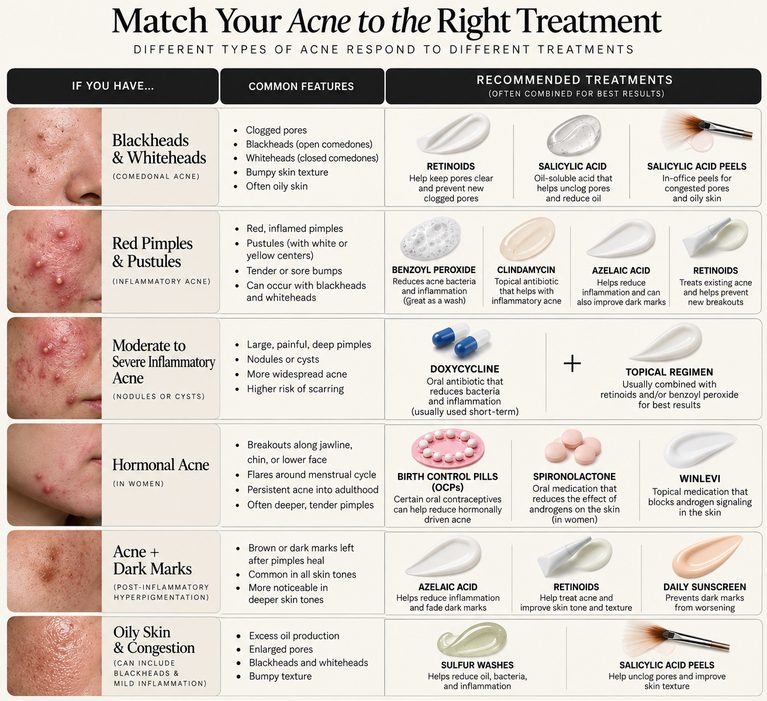
What Are the Different Types of Acne?
Identifying the type of acne you have can help determine which treatments are most appropriate.
Comedonal Acne: Blackheads and Whiteheads
Comedonal acne consists predominantly of clogged pores rather than red, inflamed pimples.
It includes:
- Open comedones (blackheads)
- Closed comedones (whiteheads)
The skin may also look bumpy or uneven even when there aren’t many obvious red pimples.
Because abnormal clogging of the follicle is the primary problem, treatments that help normalize skin-cell turnover and prevent clogged pores are particularly important for this type of acne.
Inflammatory Acne: Red Pimples and Pustules
When inflammation becomes more prominent, patients develop papules and pustules.
Papules
Papules are the classic red, raised, inflamed pimples that do not necessarily contain visible pus.
Pustules
Pustules are inflamed pimples with a visible white or yellow center.
Patients can have both comedonal and inflammatory acne at the same time, which is extremely common.
Nodular and Cystic Acne
Deeper inflammation can result in nodules and cyst-like lesions.
These tend to be:
- Larger
- Deeper beneath the skin
- Painful or tender
- Longer lasting
- More likely to cause permanent scarring
In severe cases, deep inflammatory lesions can connect beneath the skin and form larger areas of inflammation.
This is the type of acne where I especially encourage patients to see a dermatologist rather than repeatedly trying over-the-counter products. Preventing the next scar is much easier than treating an acne scar once it has formed.
What About Hormonal Acne?
Patients frequently use the term “hormonal acne” to describe acne that tends to flare with hormonal changes.
Androgens can increase sebaceous gland activity and oil production, which can contribute to clogged pores and inflammation.
Hormonal influences are particularly important in certain patients with persistent or recurrent acne, and recognizing this pattern can influence which treatments a dermatologist recommends.
I’ll discuss hormonal acne—and the treatments we use for it—in greater detail later in this acne series.
Does Diet Cause Acne?
The relationship between acne and diet is more complicated than social media sometimes makes it seem.
Research suggests that certain dietary factors may contribute to acne in some people, particularly:
- High-glycemic diets
- Skim milk
- Whey protein
However, diet is not the sole cause of acne, and eliminating foods unnecessarily is not the answer for every patient.
If you notice a consistent relationship between a particular food and your breakouts, it is worth discussing with your dermatologist.
Why Does Acne Leave Dark Spots?
Sometimes the pimple disappears—but its reminder doesn’t.
Inflammation from acne can leave behind post-inflammatory hyperpigmentation, or PIH. These are flat brown or dark marks that remain after an acne lesion heals.
Other patients, particularly those with lighter skin tones, may develop persistent pink or red marks known as post-inflammatory erythema.
These marks are not true acne scars and can gradually fade, although treatment can help accelerate their improvement.
Why Does Acne Cause Scarring?
Deeper inflammation can damage the normal collagen structure of the skin.
As the skin heals, it may produce too little or too much collagen, resulting in a permanent change in skin texture.
Common acne scar types include:
- Ice-pick scars – narrow, deep indentations
- Boxcar scars – wider depressions with more defined edges
- Rolling scars – broader depressions that create an uneven or wavy appearance
- Hypertrophic or keloid scars – raised scars caused by excess scar tissue
Deep nodules and cysts carry a particularly high risk of scarring.
This is why treating active acne early is so important. Once a true acne scar forms, topical skincare alone generally cannot completely correct the underlying structural change.
Acne Is Not One-Size-Fits-All
One of the most important things I tell patients is that acne is not simply one disease that gets treated the same way in everyone.
One patient may primarily have clogged pores and blackheads. Another may have hormonally influenced inflammatory acne. Someone else may have painful nodules that are already beginning to scar.
The best acne treatment plan depends on:
- The type of acne
- Severity
- Location
- Skin type
- Presence of dark spots or scarring
- Previous treatments
- Hormonal factors
- Individual goals and preferences
At Rangel Dermatology, I create individualized acne treatment plans based on what is actually driving each patient’s acne rather than relying on a one-size-fits-all skincare routine.
When Should You See a Dermatologist for Acne?
Consider seeing a board-certified dermatologist if:
- Your acne isn’t improving with over-the-counter products
- You develop painful or deep pimples
- Your acne is leaving dark marks
- You are beginning to develop acne scars
- Your breakouts are affecting your confidence or quality of life
- You’re unsure which products or medications you should be using
Early treatment is especially important when acne is beginning to scar.
Acne Treatment in Miami
At Rangel Dermatology in Miami, acne treatment is personalized based on your acne type, skin type, and individual concerns.
Depending on the patient, treatment may include topical medications, oral medications, hormonal therapies, isotretinoin (Accutane), skincare recommendations, or procedures designed to address the pigmentation and scarring that acne can leave behind.
Understanding why your acne is happening is the first step. The next is choosing treatments that target those specific causes.